
What do I as a marketer need to know about search marketing?
There is only one answer to that question – a lot. The existence of search engines and how our customers use them have radically changed the communications landscape; there is no doubt about it. We have to have an understanding of what it means to us. Take a look at some facts around the topic:
1) Global search markets draws more than 100 billion searches per month, an increase of 41 % year on year. Europe is the market that accounts for the highest share and Google is the top search engine, which is maybe not that surprising.
2) Number of words in Google search queries continues to inrease. The average in the US is 3, in Scandinavia 2,2
3) Research from the UK market shows that 40 % of the visitors to UK e-commerce sites start with search. Of those, 90 % access the site from the organic search result, 10 % from sponsored links.
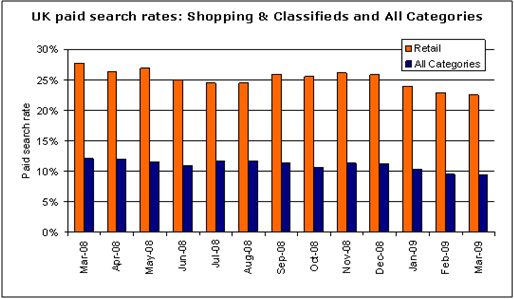
Search is the fastest way to find relevant information for the consumer. We use it all the time. The figures are staggering, in Europe in July 2009, more than 36 billion searches were conducted. For me as a marketer and Web site owner, it means that I have to think about how my potential customers and existing customers act when they are starting their purchasing cycle, i.e. the key words that they use, to capture that search traffic and drive them to my site. You may be in the business of providing low cost airfares but it’s most likely that people will search for cheap flights. You need to optimize your Web site so that the search engines actually match the search with your site. If the search engines can’t “understand” the content and what you are presenting on the site, your digital visibility will be poor. And of course we all want to end up on the first page when the results are presented, since a staggering number never visits page 2. In fact many don’t scroll down beyond the fourth in the list. Yes, it is a cruel online world!
But the challenge for many organizations is getting there. Where to start? How to gather the knowledge? Your SEO is influenced by many factors. The quality of the content, how it is created, technology (the quality of the code) and site design, how many other Web sites compete with you as well as their ranking, links to your site, the technology and how the Web site is coded. You need to look at all of these to ensure that your ranking is good. An excellent blog post about this is the SEO Hierarchy. It gives good guidelines into how you can approach SEO. The basic thing here is that you can accomplish a lot with what you already have and that you need to incorporate this into your daily management and development of your Web site. An important aspect here is the understanding how it will impact your technical development team, whether it is a in-house team or an external partner, as well as taking into consideration your content contributors and of course the business owners that are dependent on the results your Web site can deliver.
I am running this project on EPiServer.com to improve our results in organic search results and improve our page rank. Here is what we are doing:
1) We started off with a thorough analysis of which keywords are important to us and what we know our customers search on. Google was our main priority being the most used search engine in the regions that are important to us. We used their key word search tool, which has worked well for us.
2) We ar workgin our way through the site, page by page, to ensure that the key words are reflected
3) We are improving our site architecture, both from a technology perspective and from a content perspective, ensuring that title tags are in order, our headlines are good, in the right structure and that the site is search friendly from a technology perspective. We still have lots of work to do here but we have the information on what we need to do and that is a good starting point.
4) We are improving the Web site design and navigation for our key processes. Constantly working with the pages where we have high bounce rates to make them stickier and testing different pages against each other.
5) We have a created a link strategy which is still in the development phase, but we are making good progress.
So far, the results are good. Traffic from the search engines have increased so that it now accounts for close to 50 percent of our total traffic. More important, the conversion rates for our key goals are much higher, with the results for one of the goals more than doubling from one quarter to the next. By starting off with analytics as the foundation and being very clear with what we wanted to achieve, we were able to measure and see that our investment in time and effort has really paid off.

Comments