


Who really is (or was) Merriam Webster?
An increasing number of EPiServer CMS editors write text for the Web in a language other than that native to them. Many Web sites created in countries that do not have English as a first language are localized to include English and other languages. Anyone responsible for the production/translation of text into English will naturally - hopefully - want the English text to have the same quality as the original text.
Working with English texts all day every day at EPiServer, I also often need a bit of language help along the way. OK, I may be a native speaker, being born in the UK, but that doesn't automatically mean that I can spell everything right the first time, especially since I have to spell everything right in American English and not British English.
One tool that I couldn't live without in my day-to-day work as a tech writer is the Merriam-Webster online toolbar. Merriam-Webster Online (http://www.m-w.com) is THE dictionary for American English, but who really is (or was) Merriam Webster? Did he or she ever exist? I was interested to know and came up with the following information after a bit of research.
Noah Webster of Connecticut, USA, published the first truly American dictionary, "A Compendious Dictionary of the English Language" in 1806. After Noah Webster's death in 1843, the Merriam brothers bought the rights to Webster's dictionary. The rest is history and now it's possible to search the dictionary directly from a toolbar in your Web browser. Noah Webster would be amazed if he could see what had happened to his first dictionary.
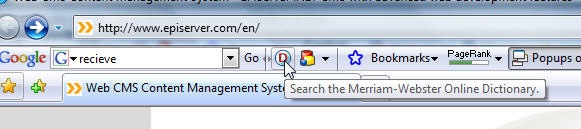
Download the Merriam-Webster Online Toolbar for Internet Explorer from http://www.merriam-webster.com/downloads/general/toolbar_ie.htm. Afterwards you can easily search the dictionary by entering your search word in the search box and clicking the Dictionary icon. It couldn't be easier!
Are you looking to expand your English vocabulary and impress others at work? Subscribe to the Word of the Day and learn a new English word every day at http://www.merriam-webster.com/cgi-bin/mwwod.pl.

Comments